• Link to X
  • Link to Facebook
Herschel Society
  • The Herschels
    • Herschel Resources
    • Publications
  • Astronomy
    • Astronomy Miscellany
    • Caroline Herschel Prize Lectureship
  • Music
  • Events
  • The Society
    • Membership
    • Donation to the Charity
    • Safeguarding
    • Society documents
  • Links
  • Click to open the search input field Click to open the search input field Search
  • Menu Menu

Friday 1st May 2026 How Stars Are Born

in Archive/by Tony Symes

Dr Andrew Wilson, University of Exeter

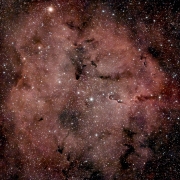
The image is a photo of the young star cluster and nebula IC 1396 © Dr Andrew Wilson

Our modern ideas about star formation date back to Immanuel Kant’s nebular hypothesis of 1755. Over the past 270 years, advances in telescopes and computing have allowed us to confirm and add details to our understanding of the process. Star formation begins with an interstellar cloud of cold gas and dust which has started to collapse under its own gravity. The contracting cloud forms an accretion disc with a protostar at its centre. As the star evolves, the cloud dissipates revealing the newly formed star. The dust within the disc clumps together, leading to the formation of a planetary system. Andy will explain our current understanding of star formation and how it connects with his research into the distribution of star formation and starspots on young stars.

Dr Andrew Wilson
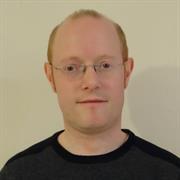
Andy Wilson has been interested in astronomy since the 1980s. He studied Astronomy and Physics at University College London in the 1990s, after which he pursued a career in IT. He retained his interest in astronomy and went back to university in 2001 as a part-time student. First studying for a mathematics degree with the Open University, followed by a PhD in astronomy at the University of Exeter which he completed in 2024. He is now a Postdoctoral Research Fellow in the Astrophysics Group at the University of Exeter, where he carries out research into star formation and young stars. He is a member of the WEAVE Stellar, Circumstellar and Interstellar Physics Team, using the WEAVE spectrograph installed on the William Herschel Telescope on La Palma. He is using WEAVE spectra to follow up on candidate young stars identified by an explainable machine learning classifier he created to analyse the distribution of star formation in the nearby Milky Way. He also uses spectra obtained with the Very Large Telescope in Chile to investigate starspot coverage on young stars. Andy still does amateur astronomy and is involved with the British Astronomical Association, where he manages the photometry and spectroscopy databases of the Variable Star Section.

A video recording of this lecture will be available here shortly.
https://herschelsociety.org.uk/wp-content/uploads/2026/01/Young-star-cluster-scaled.jpg 2260 2560 Tony Symes http://herschelsociety.org.uk/wp-content/uploads/2023/07/Herschel_logo_RGB2-300x267.jpg Tony Symes2026-04-14 15:15:192026-06-26 13:31:25Friday 1st May 2026 How Stars Are Born

Friday 6th November 2026 Invisible Rainbows: Exploring the Universe Beyond Our Senses

in Featured, Future/by Tony Symes

Dr Alfredo Carpineti

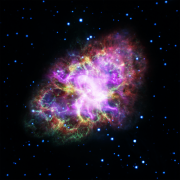
The image is of the Crab Nebula (Credit: NASA, ESA, G. Dubner (IAFE, CONICET-University of Buenos Aires) et al.; A. Loll et al.; T. Temim et al.; F. Seward et al.; VLA/NRAO/AUI/NSF; Chandra/CXC; Spitzer/JPL-Caltech; XMM-Newton/ESA; and Hubble/STScI).

There is much more to the universe that meets the eye. In this lecture, we will discover the powerful phenomena, extraordinary events, and prodigious objects that populate the universe and how incredible that we have been able to find it with the light that we cannot see.

From the emanations of powerful cosmic explosions in gamma-rays to galaxies glowing in radio waves, he shows how every colour we see is just one note in the vast symphony of light.

Featuring conversations with LGBTQIA+ astronomers and scientists from around the world, Carpineti focuses on their pivotal but often invisible contribution to the evolving field of astronomy, and how our identities can shape the way we look at the universe.

Dr Alfredo Carpineti is an astrophysicist, science journalist, and award-winning social activist.

He is the Space & Physics Editor for IFL Science, where he has worked for 10 years, writing over 6,000 articles that have been read by millions. His first book, Invisible Rainbows, came out in May 2026, published by Wilton Square Books.

Tickets (£4 – £6, proceeds to the BRLSI) available here.

https://herschelsociety.org.uk/wp-content/uploads/2026/09/2000x2000.png 2000 2000 Tony Symes http://herschelsociety.org.uk/wp-content/uploads/2023/07/Herschel_logo_RGB2-300x267.jpg Tony Symes2026-04-06 17:18:482026-10-06 11:29:42Friday 6th November 2026 Invisible Rainbows: Exploring the Universe Beyond Our Senses

Friday 4th December 2026 The Sustained Gaze

in Featured, Future/by Tony Symes

Interdisciplinary perspectives, visual arts practice and the curation of ‘Cosmos: The Art of Observing Space’

Ione Parkin RWA

The main image is Dust – Gas – Light (oil on canvas) © Ione Parkin

Bath-based visual artist Ione Parkin RWA presents a richly-illustrated talk, discussing the curation of the art-science exhibition Cosmos: the Art of Observing Space at the Royal West of England Academy, Bristol (Jan-April 2026), touring to Aberdeen Art Gallery (Nov 2026-April 2027). She will share insights into the themes and scope of the exhibition which includes work by over 30 contemporary artists and historical items loaned from public collections including the Royal Astronomical Society and the BRLSI. She will discuss her paintings relating to astronomy, cosmology and planetary atmospherics and her interdisciplinary dialogue with space scientists over a 10-year period.


Ione Parkin is an artist, curator and elected Royal West of England Academician (RWA).

She is an Honorary Visiting Fellow of the School of Physics and Astronomy, University of Leicester, and co-leads the art–astronomy project Creativity and Curiosity www.creativityandcuriosity.co.uk. She has exhibited widely including New York, Baltimore, London, Berlin, Glasgow, Birmingham and the Outer Hebrides and has contributed to interdisciplinary conferences in the UK, Italy, Germany, Spain and the Netherlands. She delivered the John Brown Memorial Lecture at the Royal Astronomical Society in 2024. https://ioneparkin.com/about.

Tickets (£4 – £6, proceeds to the BRLSI) available shortly.

https://herschelsociety.org.uk/wp-content/uploads/2026/09/IoneParkinRWA_Dust-Gas-Light-oil-on-canvas-153-x-121cm.jpg 1559 1242 Tony Symes http://herschelsociety.org.uk/wp-content/uploads/2023/07/Herschel_logo_RGB2-300x267.jpg Tony Symes2026-04-05 17:14:112026-09-18 17:23:22Friday 4th December 2026 The Sustained Gaze

Pages

  • Astronomy
  • Astronomy Miscellany
  • Caroline Herschel Prize Lectureship
  • Changes to Membership Subscriptions 2020
  • Donation to the Charity
  • Events
  • Herschel Resources
  • Home
  • Links
  • Membership
  • Music
  • Publications
  • Safeguarding
  • Society documents
  • Thankyou
  • The Herschels
  • The Museum
  • The Society

Categories

  • Archive
  • Featured
  • Future
  • Recorded Lectures

Archive

  • August 2026
  • July 2026
  • April 2026
  • December 2025
  • October 2025
  • May 2025
  • April 2025
  • March 2025
  • January 2025
  • December 2024
  • November 2024
  • October 2024
  • September 2024
  • July 2024
  • June 2024
  • April 2024
  • March 2024
  • February 2024
  • January 2024
  • November 2023
  • October 2023
  • September 2023
  • May 2023
  • April 2023
  • March 2023
  • February 2023
  • December 2022
  • November 2022
  • October 2022
  • September 2022
  • May 2022
  • April 2022
  • March 2022
  • February 2022
  • November 2021
  • October 2021
  • September 2021
  • June 2021
  • May 2021
  • April 2021
  • March 2021
  • February 2021
  • November 2020
  • October 2020
  • September 2020
  • June 2020
  • February 2020
  • January 2020
  • November 2019
  • October 2019
  • May 2019
  • January 2019
  • September 2018
  • June 2018
  • May 2018
  • April 2018
  • March 2018
  • December 2017
  • September 2017
  • May 2017
  • March 2017
  • December 2016

Interesting links

Here are some interesting links for you! Enjoy your stay :)

Pages

  • Astronomy
  • Astronomy Miscellany
  • Caroline Herschel Prize Lectureship
  • Changes to Membership Subscriptions 2020
  • Donation to the Charity
  • Events
  • Herschel Resources
  • Home
  • Links
  • Membership
  • Music
  • Publications
  • Safeguarding
  • Society documents
  • Thankyou
  • The Herschels
  • The Museum
  • The Society

Categories

  • Archive
  • Featured
  • Future
  • Recorded Lectures

Archive

  • August 2026
  • July 2026
  • April 2026
  • December 2025
  • October 2025
  • May 2025
  • April 2025
  • March 2025
  • January 2025
  • December 2024
  • November 2024
  • October 2024
  • September 2024
  • July 2024
  • June 2024
  • April 2024
  • March 2024
  • February 2024
  • January 2024
  • November 2023
  • October 2023
  • September 2023
  • May 2023
  • April 2023
  • March 2023
  • February 2023
  • December 2022
  • November 2022
  • October 2022
  • September 2022
  • May 2022
  • April 2022
  • March 2022
  • February 2022
  • November 2021
  • October 2021
  • September 2021
  • June 2021
  • May 2021
  • April 2021
  • March 2021
  • February 2021
  • November 2020
  • October 2020
  • September 2020
  • June 2020
  • February 2020
  • January 2020
  • November 2019
  • October 2019
  • May 2019
  • January 2019
  • September 2018
  • June 2018
  • May 2018
  • April 2018
  • March 2018
  • December 2017
  • September 2017
  • May 2017
  • March 2017
  • December 2016
© 2020 The Herschel Society | site by Decent | Our Privacy Policy
Scroll to top Scroll to top Scroll to top