
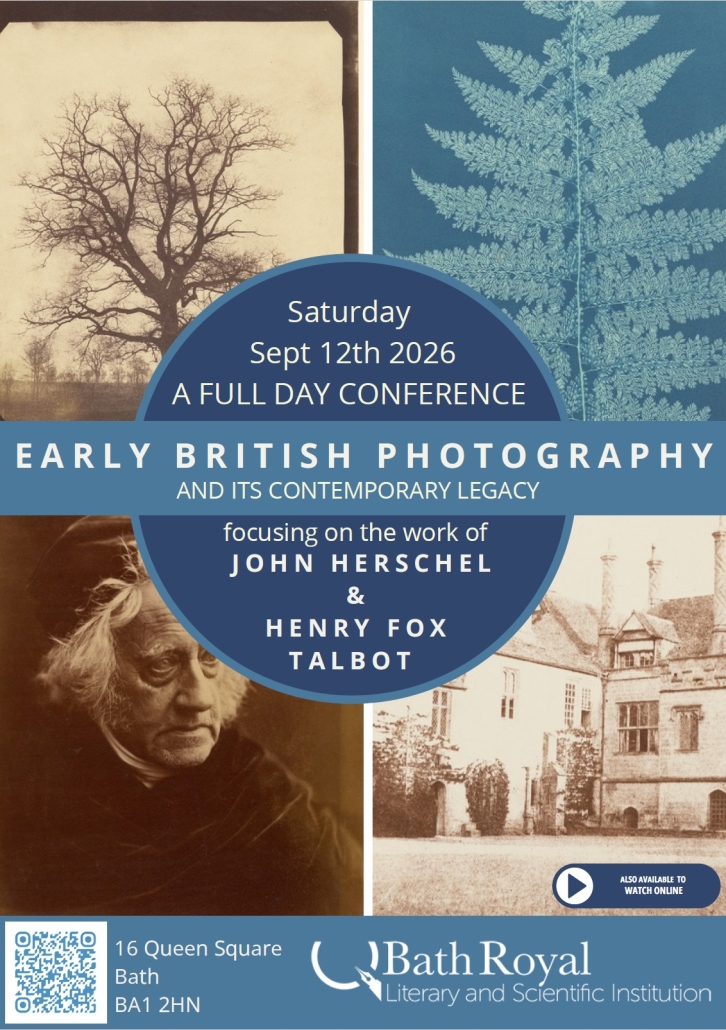
Saturday 12th September 2026 Early British Photography and its Contemporary Legacy: an all-day conference 9.45am – 5.30pm
Join us for a packed day of talks exploring early British Photography and the work of John Herschel and Henry Fox Talbot at the BRLSI and on Zoom
Early British photography was rooted in the experimentation of Henry Talbot, John Herschel and their extended family, scientific and artistic networks, and the French daguerreotype process. Talbot’s announcement of his photogenic drawing process in 1839, and calotype process in 1841, Herschel’s cyanotype in 1842, and the commercialisation of the daguerreotype from 1841 saw amateur and professional photography flourish. These processes were overtaken by collodion from the early 1850s. This conference explores the contributions of Talbot and Herschel and their circles, wider themes in early photography, and the continuing legacy of this period with contemporary artists.
Video recordings will be available here shortly.
Programme
9.45 WELCOME & INTRODUCTION
Charles Draper, Herschel Society Chairman10.00-10.20 INTRODUCING EARLY PHOTOGRAPHY
To set the scene for the day Michael Pritchard will look at how Talbot and Herschel studies have evolved since the nineteenth century. He will show how their respective experiments and achievements have left a legacy that still resonates with contemporary artists and photographers. Dr. Michael Pritchard, former CEO Royal Photographic Society and photo-historian
10.20-11.40 HERSCHEL, TALBOT AND THEIR CIRCLE
Introduction. Professor Mike Edmunds, President, Herschel Society- Lacock, The Home of Photography. Dr. Andy Cochrane,National Trust Property Curator, Lacock and North Wiltshire, with responsibility for Lacock Abbey, the Fox Talbot Museum, botanic garden and grounds.
- Defining Photography. Sir John Herschel played a critical role in all aspects of the development of photography. He invented some of its chemistry, popularised some of its terms, deployed photographs as evidence, and collected them as art and technology. But photography failed to fit some of his most cherished general laws, caused him endless difficulties and resulted in numerous failures. How did Herschel help to define what we know as photography today in the face of so much uncertainty as to what it was and how it fit into science as it was known at the time? This talk discusses Herschel’s attempts to place and classify photography in his worldview. Professor Emerita Kelley Wilder
- The First Essay in Social Documentary: Hill and Adamson’s Fisherwomen and Men of the Firth of Forth. Between 1844 and 1846, D O Hill, Robert Adamson and Jessie Mann, working in Edinburgh, and using the Calotype process undertook an original exercise working principally with the fishing community of Newhaven on the Firth of Forth. Through aesthetic and technological experiments, they determined to picture the excellence and distinction of this small society. The results remain an extraordinary challenge even in our own times. Dr. Sara Stevenson
- John Herschel’s Photographic Legacy. John Herschel’s photographic legacy is as vast as it is multifaceted, yet he left only a partial and superficial mark on the historiography of the medium. Despite the limited time he was able to devote to this emerging medium, he made decisive contributions to it, both practical and theoretical. This thesis studies his presence and absence in the pages of the history of photography and proposes hypotheses to explain the gaps observed in his (re)cognition. Anne-Lou Buzot.
11.40-11.55 – Coffee

11.55 – 13.00 PHOTOGRAPHY ORIGINS AND ACCEPTANCE 1834-1861
Introduction. Charles Draper- Silent trailblazers: four early women photographers and their studios in Bath. This talk introduces four of the earliest women professional photographers in Bath. The photographic studios of Hannah Whaite, Emma Roper, Lucy Williams and Emma Tuttell represent inspirational stories of resilience and commercial acumen at a time of widespread social restriction for women. These four trailblazers overcame professional and personal challenges to become the wives, widows and unmarried women who relocated a ‘woman’s place’ from domesticity to a photographic studio, establishing a unique creative legacy in the city of Bath. Dr. Rose Teanby
- John Herschel & Photography in the Long 1840s. John Herschel and Henry Talbot (more commonly referred to as William Henry Fox Talbot) had first met in 1824 and had a common interest in light. Both were to become pioneers of early photography.This paper will examine the social, institutional, and commercial environments in which photography evolved during the 1840s, ending in the 1851 Great Exhibition, which acted as a major catalyst to propel the medium into the mainstream. Dr. Anthony Hamber.
- Recording the appearances of the heavens: Warren De La Rue’s application of photography to astronomy in 1857. At the November 1857 meeting of the Royal Astronomical Society meeting, the pioneering photographer Warren De La Rue exhibited the results of his photographic experiments using collodion so sensitive that it could show the belts of Jupiter, and details of the lunar surface that surpassed drawings in accuracy. Many original photographs from this pivotal moment in astrophotography survive in the RAS collections today and will be used to illustrate this talk. Dr. Sian Prosser
13.00-14.15 – Lunch break

14.15 – 15.30 HISTORIC PHOTOGRAPHIC PROCESSES & CONTEMPORARY PRACTICE
Introduction. Dr. Michael Pritchard- Collaborative Practice with Nineteenth Century Photographic Processes. Artist Jo Gane will talk from her perspective as a contemporary practitioner of the Calotype, Wet Plate Collodion and Daguerreotype processes about the layers of collaboration in her work. Working with people, chemicals and places to make photographs that are often co-authored with others, she uses her contemporary collaborations to generate knowledge about the practicalities of working with early photography. This practice-based knowledge informs her research and understanding of collaborative networks of nineteenth century scientists and industrialists active in Birmingham during the 1840s.In this talk, she will discuss her experiences of making photographs and outline how the materials and technical constraints of early photographic processes force collaboration and connect early photography to specific places. Dr. Jo Gane
- Intimate Ecologies: Recontextualising Early Photographic Processes in Contemporary Art. Kristina Chan presents her paper on early photographic processes and their contemporary application in landscape practice. Drawing on Anna Atkins’ cyanotypes and Talbot’s pursuit of nature through light, Chan examines Lucid Dreams(Royal Photographic Society), Shared Latitudes (Bergen, Norway), and Habitable Climes (High Commission of Canada, Royal Geographical Society), informed by her sustained engagement with historical archives. Kristina Chan, MA
- ‘pray go on with these delightful experiments…’ Herschel, Somerville, and the Making of Colour Photography. This paper explores the collaborative nature of John Herschel and Mary Somerville’s photographic conversations. It does so by turning to art practice and processes of reenactment, and addresses two questions: how does a repositioning of Somerville as a photographer (in this instance, through her 1835 and 1845 experiments) change the way we think about the history of the medium? And how can photographic art practice contribute to the task of locating Somerville in the early history of photography? Dr. Caroline Douglas
15:30-16:30 Wrap Up and Q&A – All Speakers (Chaired by Charles Draper)
16.30 – 17.30 – Drinks and close
Tickets (£18 – £36) available here.
