
Friday 1st May 2026 How Stars Are Born
Dr Andrew Wilson, University of Exeter
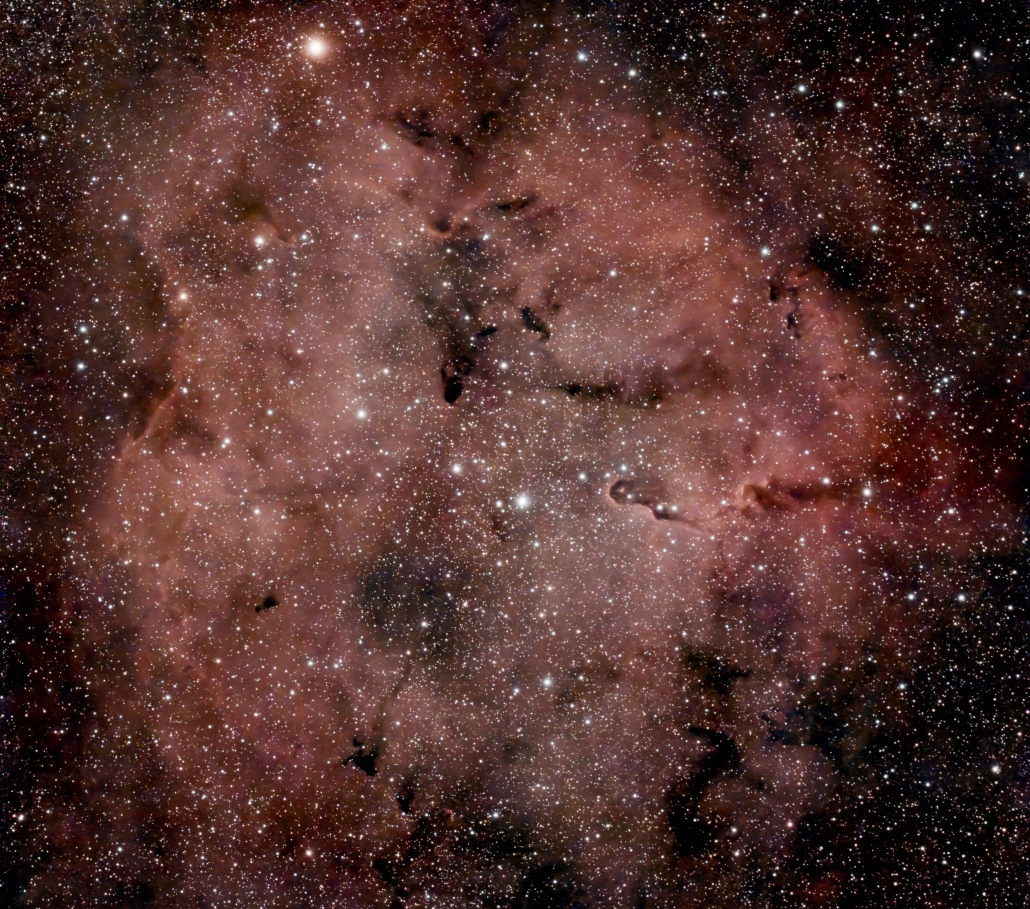
The image is a photo of the young star cluster and nebula IC 1396 © Dr Andrew Wilson
Our modern ideas about star formation date back to Immanuel Kant’s nebular hypothesis of 1755. Over the past 270 years, advances in telescopes and computing have allowed us to confirm and add details to our understanding of the process. Star formation begins with an interstellar cloud of cold gas and dust which has started to collapse under its own gravity. The contracting cloud forms an accretion disc with a protostar at its centre. As the star evolves, the cloud dissipates revealing the newly formed star. The dust within the disc clumps together, leading to the formation of a planetary system. Andy will explain our current understanding of star formation and how it connects with his research into the distribution of star formation and starspots on young stars.
Dr Andrew Wilson
Andy Wilson has been interested in astronomy since the 1980s. He studied Astronomy and Physics at University College London in the 1990s, after which he pursued a career in IT. He retained his interest in astronomy and went back to university in 2001 as a part-time student. First studying for a mathematics degree with the Open University, followed by a PhD in astronomy at the University of Exeter which he completed in 2024. He is now a Postdoctoral Research Fellow in the Astrophysics Group at the University of Exeter, where he carries out research into star formation and young stars. He is a member of the WEAVE Stellar, Circumstellar and Interstellar Physics Team, using the WEAVE spectrograph installed on the William Herschel Telescope on La Palma. He is using WEAVE spectra to follow up on candidate young stars identified by an explainable machine learning classifier he created to analyse the distribution of star formation in the nearby Milky Way. He also uses spectra obtained with the Very Large Telescope in Chile to investigate starspot coverage on young stars. Andy still does amateur astronomy and is involved with the British Astronomical Association, where he manages the photometry and spectroscopy databases of the Variable Star Section.
Tickets (£6 or £3 for BRLSI or Herschel Society members and students, proceeds to the BRLSI) available here.
Herschel Society Members receive a discount code in the announcement that is mailed to them.

